Exercises for Golf Fitness: 12-Week Plan and Score Check
The best exercises for golf fitness cover five areas: mobility (hips, upper back, shoulders), lower-body strength, upper-body push and pull, rotational core work, and explosive power. Do them 2–3 times a week on non-consecutive days, then check your score differentials after 12 weeks to see whether your scores dropped.
Most fitness pages promise more speed or distance and stop there. A faster swing only matters if your scores come down. This page gives you the plan and the number to check afterward.
The weekly plan at a glance
Shirley Ryan AbilityLab recommends 2–3 sessions a week alongside range and putting practice. Fit For Golf prescribes 3 workouts a week of 20–60 minutes, done on non-consecutive days.
| Block | What | Sets x reps | Rest |
|---|---|---|---|
| Warm-up and mobility | 90/90 hip rotation, half-kneeling thoracic rotation, opposite heel taps, hand walk-outs | 1 x 10 each | Minimal |
| Power circuit | Countermovement jumps, high-speed band rotations, ballistic push-ups | 2–3 x 5–6 | 30–60 s |
| Strength | Split squat, dumbbell bench press, single-arm row | 2–3 x 5–8 | 60–90 s |
| Core and balance | Pallof press, banded rotations, planks, single-leg work | See below | 30–60 s |
The warm-up, power and strength structure comes from Fit For Golf. A full session fits in 40–50 minutes.
Exercises for golf fitness, by category
Mobility
Start every session with the World's Greatest Stretch, as Golf Digest's trainers suggest. Then do the Fit For Golf warm-up: 90/90 hip rotations, half-kneeling thoracic rotations, opposite heel taps and hand walk-outs, 1 set of 10 each.
Shirley Ryan AbilityLab adds a hip flexor stretch held 20–30 seconds for 2–3 sets per leg. Stix Golf uses 30–60 seconds. Pick one and stay with it.
Lower-body strength
Use squats, split squats and hip hinges. A goblet squat to a box is a safe start. Do 2–3 sets of 5–8 reps with 60–90 seconds between exercises. Shirley Ryan AbilityLab also lists single-leg bridges for 8–12 reps per leg.
Upper-body push and pull
Rows and push-ups cover it. Use a single-arm row and a dumbbell bench press, or an incline push-up if full push-ups break your form. Same dose as the strength block: 2–3 sets of 5–8.
Rotational core
This is the golf-specific part.
- Banded core rotations: 8–12 reps per side (Shirley Ryan AbilityLab).
- Pallof press and pulley woodchop: 2–3 sets of 8–12 per side (the range is my suggestion, matching the banded rotation dose).
- Split-stance band torso rotations: turn the upper body against a still lower body (Golf Digest).
- Banded lateral steps with torso twists: a Golf Digest drill for fixing sway and slide.
- Planks: hold 30–60 seconds (Stix Golf). Side planks and plank rotations count too.
- Russian twists: 10–15 reps per side (Stix Golf).
Explosive power
Med-ball rotational slams train downswing sequencing (Golf Digest). Countermovement jumps and high-speed band rotations fit the power circuit: 2–3 sets of 5–6 reps, 30–60 seconds rest. Move fast. Stop the set when the reps slow down.
Balance and the lower back
Jon Hodgkinson cites TrackMan data putting the average male amateur's club speed at 93.4 mph. He says that swing can put compressive forces of up to 8 times body weight on the lower back. He also cites research that balance training lowered injury risk by 45%. Add single-leg balance and reach, 2 sets per leg, to the end of each session.
Grip and conditioning
Stix Golf recommends farmer's walks for grip and conditioning, and finger extensions for 10–15 reps.
Lift for speed too
Heavy lifting builds strength. Golf needs strength produced quickly. Fit For Golf cites a meta-analysis (Guizelini 2018, adults 60+, 4–16 weeks) where maximal strength rose about 18% and rate of force development about 27%, and the two did not improve together. It also cites Caserotti 2008 (women aged 80–89, 12 weeks) where lifting 75–80% of 1RM with fast intent produced about 51% more rate of force development and about 28% more maximal strength.
Those groups are older than most readers. Treat the result as a direction: lift with fast intent, and keep the power circuit in every session.
A 12-week block
Healthline suggests focusing on one phase for 4–8 weeks. Here is a 12-week version built from its pre-season phases, with the Fit For Golf power circuit in both halves.
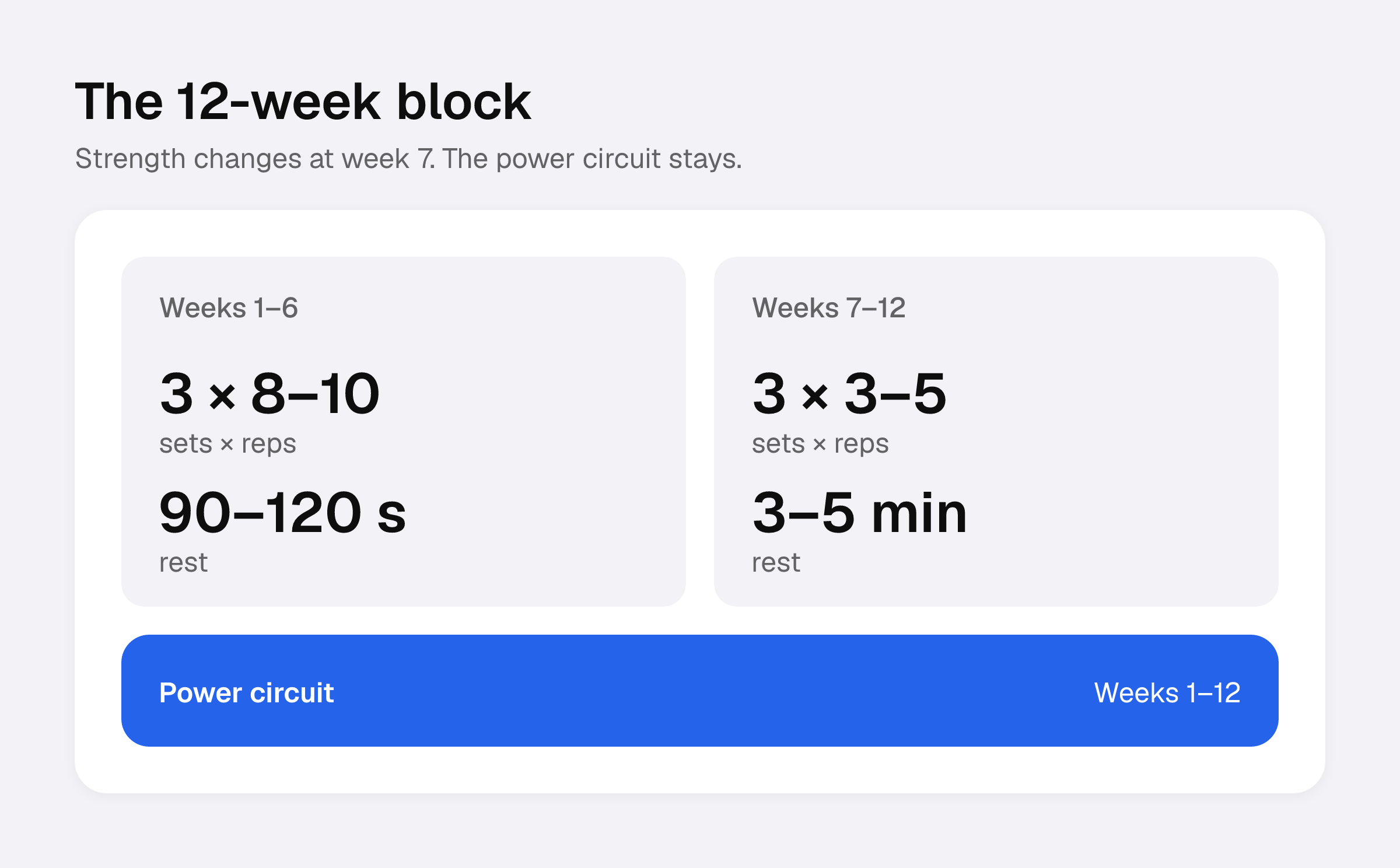
- Weeks 1–6: strength exercises at 3 sets of 8–10 reps, 90–120 seconds rest.
- Weeks 7–12: strength exercises at 3 sets of 3–5 reps, 3–5 minutes rest. Keep the power circuit.
Leave 1–2 reps in the tank and stop before failure. Healthline notes an 8-week strength and power program improved club speed in collegiate golfers, and that any resistance training is likely to help if you are not training now.
In season, Healthline drops to one maximal working set per exercise. In the off-season it uses about 60% of the pre-season loads.
Add walking for 18-hole endurance
Healthline recommends two brisk 20–30 minute walks a week, or walking instead of riding a cart for at least one round a week. Stix Golf links cardio fitness to fewer fatigue-related errors late in a round.
Check the numbers after 12 weeks
You can tell whether training worked from your scores. Use the score differential, which adjusts for course difficulty: (score − course rating) × 113 / slope.
Worked example (illustrative numbers). An 18-handicap golfer shoots 95 on a course rated 71.2 with a slope of 128.
- Before: (95 − 71.2) × 113 / 128 = 21.0
- After 12 weeks, same course, shooting 91: (91 − 71.2) × 113 / 128 = 17.5
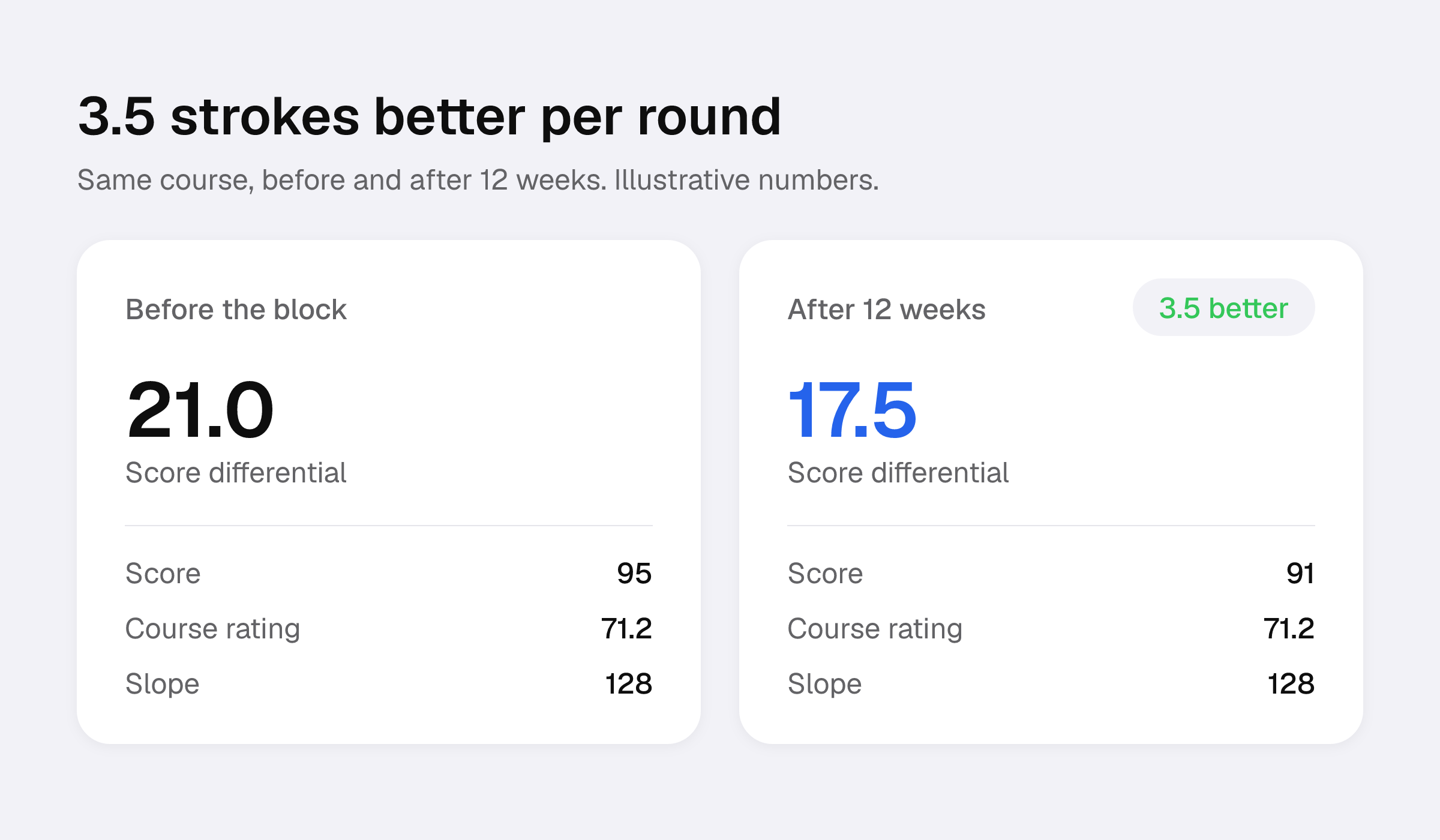
That is 3.5 strokes better per round. Run your own rounds through the golf handicap differential calculator. Then see how your Handicap Index moves with the golf handicap calculator. The index is the average of the best 8 differentials from your last 20 rounds, so it moves slowly. Compare your average differential over 5 rounds before the block with 5 rounds after. One round is too noisy.
Then check endurance. Add up your front nine and back nine for each round.
| Round | Front 9 | Back 9 | Back minus front |
|---|---|---|---|
| Before block | 45 | 50 | +5 |
| After block | 45 | 46 | +1 |
Illustrative numbers again. If the back-nine gap shrinks across several rounds, late-round fatigue is likely shrinking. Another way to find where strokes go is the five golf stats worth tracking.
Safety and older golfers
Get cleared by a doctor before you start. Progress slowly and never add load at the expense of form (Golf Digest; Healthline).
Jon Hodgkinson advises older golfers to build mobility, posture and strength before overspeed training with weighted clubs. Heavy max-effort swings raise injury risk for bodies that are not prepared for them.
No gym? The at-home golf drills guide covers indoor-friendly work, and a band and a med ball handle most of the rotation and power moves above.
Log the block
Flash Caddie is a golf scorecard app for iPhone with an Apple Watch app. Scoring is hole by hole, with a running total against par. The core app is free: scoring, round history, handicap, and course search. It computes a handicap index with the World Handicap System formula: the average of the best 8 score differentials from the last 20 rounds. Only fully scored 18-hole rounds on a course with a rating and slope count toward it.
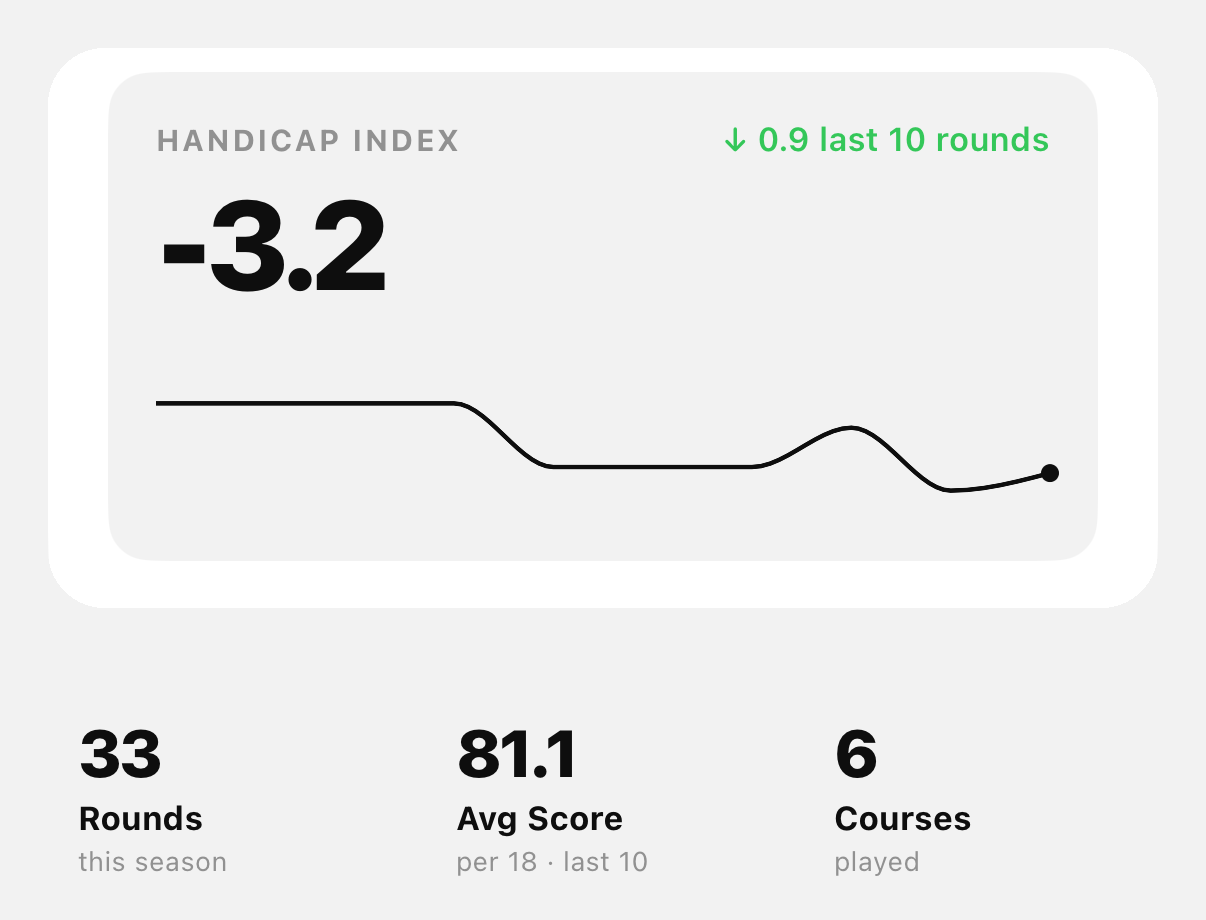
Score 5 rounds before week 1 and 5 rounds after week 12. Compare the differentials and the back-nine gap. Use how to calculate a golf handicap if you want to check the index math by hand.
Frequently asked questions
- How long before golf exercises show up in my scores?
- Healthline notes an 8-week strength and power program improved club speed in collegiate golfers. Give your own block 12 weeks, then compare the average differential of 5 rounds before and 5 rounds after.
- Do I need a gym for golf fitness exercises?
- No. Bands, a med ball and a pair of dumbbells cover the mobility, rotation, power and strength moves in the plan. Bodyweight versions such as split squats, planks and incline push-ups work to start.
- Should I train on the same day I play?
- Fit For Golf schedules its sample workout on non-consecutive days. Keep hard sessions away from round days, and use the walking and mobility work as the lighter option.
- Is walking the course enough cardio for golf?
- Healthline recommends two brisk 20–30 minute walks a week, or walking instead of taking a cart for at least one round a week. That builds the endurance to keep your back nine from slipping.
- Why compare differentials instead of raw scores?
- Raw scores change with the course. A differential uses course rating and slope, so a 91 on a hard course and a 91 on an easy one are measured fairly.
Sources
- Golf Workouts: Build Mobility, Strength, & Club Head Speed (Fit For Golf)
- The Ultimate Golf Workout Program to Up Your Game (Healthline)
- 10 of our favorite exercises for golfers (Golf Digest)
- Four Exercises to Improve Your Golf Game (Shirley Ryan AbilityLab)
- Golf Fitness 101: 16 Exercises to Improve Your Game (Stix Golf)
- The 10 Best Golf Exercises for Seniors to Improve Strength and Flexibility (Jon Hodgkinson)
Track it automatically
Flash Caddie keeps your scorecard, computes your WHS handicap, and tracks your trends. Free on iPhone and Apple Watch.