What Your Golf Handicap Means: One Golfer's 20 Rounds

Golf handicap what does it mean? A Handicap Index is a number with one decimal, like 14.7, that measures your demonstrated scoring potential. Roughly, it is how many strokes over par your better rounds suggest on a course of standard difficulty (slope 113), so your average score will run several strokes higher.
The fastest way to see this is to build one from scratch. Below is a golfer with a 16.4 Index and 20 realistic scores. We turn each score into a differential, pick the best 8, then convert the Index into strokes on three sets of tees.
The formula behind the number
Under the World Handicap System (since 2020), the Index is the average of your best 8 score differentials from your most recent 20 rounds. The old system used the best 10 of 20 times 0.96. That multiplier is gone, so do not apply it.
Each differential comes from this formula:
(Adjusted Gross Score − Course Rating − PCC) × 113 ÷ Slope Rating
Course Rating is what a scratch golfer is expected to shoot. Slope Rating runs from 55 to 155, with 113 as standard. A higher slope means the course plays harder for a bogey golfer than for a scratch golfer. PCC is a daily weather and conditions adjustment, which is zero on most days.
Two published checks you can run yourself:
- 86 on a 70.4 rating and 138 slope: (86 − 70.4) × 113 ÷ 138 = 12.8
- 92 on a 71.0 rating and 125 slope: (92 − 71.0) × 113 ÷ 125 = 18.98, or 19.0
The website has a free score differential calculator.
Worked example: 20 rounds, one 16.4 Index
Our golfer plays one home course: par 71, rating 70.8, slope 127. No PCC adjustment. Each score below is an adjusted gross score. The multiplier is 113 ÷ 127 = 0.890.
| Round | Score | Differential | Counts |
|---|---|---|---|
| 1 | 95 | 21.5 | |
| 2 | 91 | 18.0 | Best 8 |
| 3 | 98 | 24.2 | |
| 4 | 90 | 17.1 | Best 8 |
| 5 | 93 | 19.8 | |
| 6 | 96 | 22.4 | |
| 7 | 89 | 16.2 | Best 8 |
| 8 | 94 | 20.6 | |
| 9 | 99 | 25.1 | |
| 10 | 88 | 15.3 | Best 8 |
| 11 | 92 | 18.9 | |
| 12 | 97 | 23.3 | |
| 13 | 90 | 17.1 | Best 8 |
| 14 | 95 | 21.5 | |
| 15 | 87 | 14.4 | Best 8 |
| 16 | 96 | 22.4 | |
| 17 | 92 | 18.9 | |
| 18 | 90 | 17.1 | Best 8 |
| 19 | 94 | 20.6 | |
| 20 | 89 | 16.2 | Best 8 |
The best 8 differentials add up to 131.4. Divide by 8 and you get 16.425, which rounds to a 16.4 Index. The website has a free golf handicap calculator.
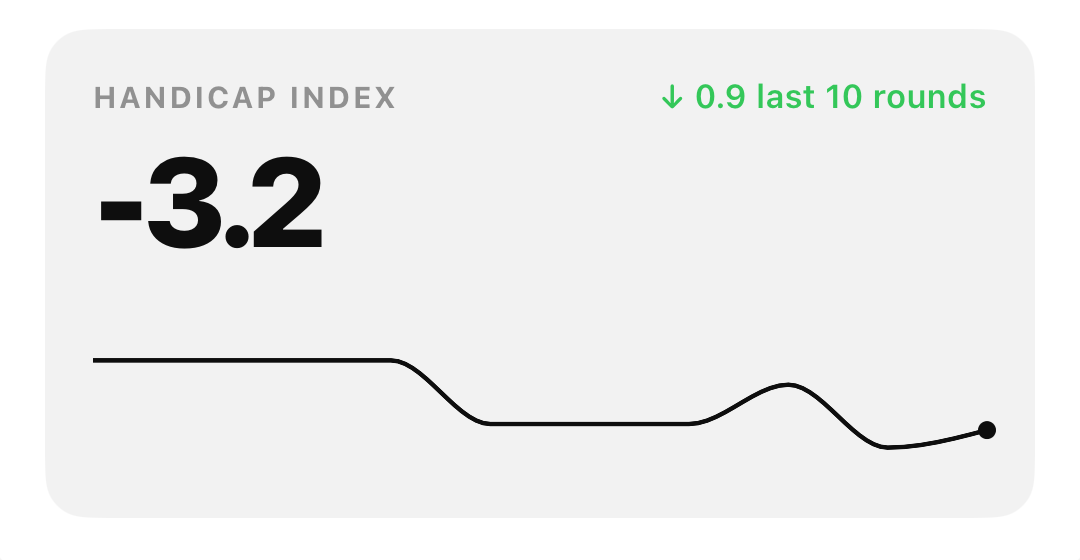
Flash Caddie runs the same best-8-of-20 math in the app and shows the result as your Handicap Index. This card belongs to a different golfer, whose Index is −3.2:
Why this golfer never plays to the number
Add up all 20 scores and the average is 92.75. The average differential is 19.5, which is 3.1 above the Index.
The best 8 rounds average 89.25 gross. Those are the rounds the Index describes. The other 12 rounds average 95.1.
That is how the system is built. The Index uses the best 8 of 20, which is the best 40% of rounds. A golfer who posts those rounds 40% of the time will see the number as a target they rarely hit.
Golf handicap what does it mean on the scorecard
The Index is the same everywhere. The strokes you get change with the tees, because the Course Handicap adjusts for difficulty:
Index × (Slope ÷ 113) + (Course Rating − Par), rounded to a whole number.
Here is our 16.4 on three sets of tees at the same par 71 course:
| Tees | Rating / Slope | Calculation | Course Handicap | Net par score |
|---|---|---|---|---|
| Forward | 68.6 / 119 | 17.27 − 2.4 = 14.87 | 15 | 86 |
| Middle | 70.8 / 127 | 18.43 − 0.2 = 18.23 | 18 | 89 |
| Back | 72.5 / 135 | 19.59 + 1.5 = 21.09 | 21 | 92 |
On the middle tees, par 71 plus 18 makes 89 the net-par target. A gross 89 minus 18 is a net 71.
Against that 89 target, our golfer's 92.75 average is 3.75 strokes over. Only 4 of the 20 rounds (87, 88, 89, 89) reached it. Another 3 rounds of 90 finished one stroke over.
Another example of the swing: a 15.0 Index might be a 13 from forward tees and a 17 from the back. The website has a free course handicap calculator. Find the rating and slope for your tees on the scorecard.
How the strokes fall on the card
Strokes go on the holes ranked hardest, using the stroke index (1 to 18) on the scorecard.
- A Course Handicap of 14 gets one stroke on each of the 14 hardest holes.
- Our 18 gets one stroke on every hole.
- Our 21 from the back tees gets one stroke on every hole plus a second stroke on the 3 hardest holes.
- In a match, a 21 playing a 14 gets 7 strokes.
What net double bogey caps a blow-up hole at
For posting, a hole is capped at net double bogey: par + 2 + any strokes you receive on that hole.
- With a Course Handicap of 18, every hole gets one stroke, so the cap is par + 3. That is a 7 on a par 4.
- A 25 handicap gets two strokes on the 7 hardest holes. The cap is a quadruple bogey there and a triple bogey on the other 11.
- While you establish an initial Index, the cap is par + 5.
Say our golfer scores 98 with one 9 on a par 4 where he gets one stroke. That hole posts as 7, so the round posts as 96, which is a differential of 22.4 instead of 24.2.
Where your number ranks
USGA end-of-2025 data on 3.68 million golfers, as reported by Golfity, puts the average Index at 14.0 for men and 28.8 for women. About 68% of men sit between 5.0 and 19.9. The largest single band is 10.0 to 14.9, at 26.48%. Under 5.0 is roughly the top 10%, and scratch is about 2%. MyGolfSpy, using 2024 data, reports 14.2 and 28.7, so expect the figures to move a little each year.
A "bogey golfer" is roughly an 18 to 20 Index for men. Our 16.4 golfer is a bit better than that benchmark.
What your number means in scores and stats
Golfity's benchmarks by handicap show typical scores and where the strokes leak. Our golfer averages 92.75 at a 16.4, which sits between the 15 and 20 rows.
| Handicap | Typical score | Greens in regulation | Putts per round | Doubles or worse per round | Three-putts per round |
|---|---|---|---|---|---|
| 10 | 84–87 | 35% | 32.5 | 3.0 | 1.8 |
| 15 | 90–92 | 23% | 33.5 | 4.5 | 2.5 |
| 20 | 95–98 | 16% | 34.5 | 6.0 | 3.2 |
| 25 | 100–103 | 9% | 35.5 | n/a | n/a |
Going from a 15 to a 10 means 12 more points of GIR, one fewer putt, and 1.5 fewer doubles per round. A 30 typically shoots 105–108.
Doubles or worse is the gap that moves scores fastest between 15 and 20: 1.5 doubles is 1.5 or more strokes per round, and each three-putt costs a stroke. Read the guide to golf stats worth tracking to pick which of these to count first. For a wider look at benchmarks, see what is a good golf handicap.
Keeping the scores to run these numbers
Every calculation above needs your hole-by-hole scores, plus the rating and slope of the tees you played. Flash Caddie is a golf scorecard app for iPhone with an Apple Watch app. Scoring is hole by hole, with a running total against par. It computes a handicap index with the World Handicap System formula: the average of the best 8 score differentials from the last 20 rounds. Only fully scored 18-hole rounds on a course with a rating and slope count toward the handicap index.
Next round, write down your score and the tees. After 20 rounds, find your best 8, and compare your average to your Course Handicap target.
Frequently asked questions
- How many rounds do I need before I get a Handicap Index?
- The minimum is 54 holes, in any mix of 9-hole and 18-hole rounds. With fewer than 20 scores, fewer differentials are used. For example, 5 scores use the lowest 1, 9 to 11 scores use the lowest 3, and 19 scores use the lowest 7.
- Why can my Index go up after I shoot a good round?
- The Index is the average of your best 8 of the most recent 20. When an older low differential drops out of that window, the average can get worse even if your newest round was good. Course difficulty also matters: a 90 on a hard course can produce a better differential than an 88 on an easy one.
- What is the highest Handicap Index possible?
- The maximum Index is 54.0. There is also a soft cap that halves any rise above 3.0, and a hard cap that limits the rise to 5.0 within 365 days.
- Is the 0.96 multiplier still used?
- No. The old system took the best 10 of 20 differentials and multiplied by 0.96. The World Handicap System dropped that multiplier and averages the best 8 of 20.
- Is an 18 handicap good?
- It is near the bogey-golfer benchmark, which is roughly an 18 to 20 Index for men. The USGA average Index at the end of 2025 was 14.0 for men and 28.8 for women, so an 18 is a few strokes above the men's average.
Sources
- What Is a Handicap in Golf? A Complete Beginner's Guide (GolfDecode)
- Golf Handicap Explained: What It Is, How It Works, and How to Get One (Lynx Golf)
- Handicap (golf) – Wikipedia
- What Is a Good Golf Handicap? Handicap Percentiles Explained (golfity)
- What Does Your Handicap Index Really Mean? (MyGolfSpy)
- Golf Handicap Index Explained | Handicap 101 (NCGA)
Track it automatically
Flash Caddie keeps your scorecard, computes your WHS handicap, and tracks your trends. Free on iPhone and Apple Watch.